
Views: 0 Author: Site Editor Publish Time: 2026-11-26 Origin: Site


Selecting the right base ingredient for joint health supplements demands careful strategy. You must balance clinical legacy alongside strict modern manufacturing realities. Consumers often view Glucosamine as a single, uniform entity on the shelf. However, product formulators know the complex truth behind the label. We must navigate stark differences in elemental yield, shelf stability, and raw material sourcing. The divide between hydrochloride and sulfate forms dictates your entire production process.
This article provides an evidence-oriented framework for R&D and procurement teams. We will help you evaluate which molecular form best aligns with your unique manufacturing capabilities. You will learn how to hit specific formulation goals, such as vegan profiles or complex combination matrices. We also cover essential regulatory and compliance requirements. By the end, you can make a confident, data-driven choice for your next major production run.
Glucosamine Hydrochloride (HCl) offers a significantly higher elemental glucosamine yield (~99%) compared to sulfate forms, allowing for smaller dosage forms.
Sulfate forms typically require stabilization (e.g., Glucosamine Sulfate Potassium Chloride), which lowers the active compound yield to roughly 74% and introduces mineral considerations.
While sulfate boasts a larger volume of legacy clinical trials, HCl is often preferred in modern manufacturing due to its superior stability, lower hygroscopicity, and availability in plant-based/fermented formats.
Switching between forms requires label adjustments and a clear understanding of regulatory claim limitations (e.g., EFSA and FDA guidelines).
Supplement brands face a challenging decision context today. You must decide whether to optimize for historical clinical trial alignment or push for manufacturing efficiency. Clean-label trends push brands toward simpler, cleaner inputs. Defining formulation success goes far beyond simply picking a popular active ingredient. A truly successful formulation achieves precise target dosages without triggering tableting failures on the line.
Furthermore, it must meet strict shelf-life stability requirements in various climates. It also needs to align perfectly with the target demographic's specific dietary restrictions. For instance, many modern consumers seek out products free from shellfish allergens. Others strictly follow vegan diets. Balancing these demands requires a deep understanding of the raw materials.
We must also address the lingering skepticism around clinical efficacy. Scientific consensus shows both major forms ultimately deliver the free active compound to the bloodstream. Once ingested, they metabolize efficiently. However, absorption rates and therapeutic outcomes remain a subject of heavy debate in clinical literature. Formulators must choose a path they can confidently defend to their consumer base.
Understanding the compound profile of the sulfate form is critical. You cannot use the pure sulfate molecule on its own. It degrades rapidly when exposed to standard atmospheric moisture. Manufacturers must combine it with a mineral salt to create a stable complex. They typically use potassium chloride or sodium chloride. This vital stabilization prevents rapid degradation during transit and storage.
This legacy standard offers several powerful formulation advantages. It maintains the strongest alignment with legacy osteoarthritis clinical trials. This makes it ideal for brands prioritizing traditional evidence-based marketing. Consumers recognize this specific name on the label. They already trust this legacy standard based on decades of market presence.
However, you must navigate significant formulation limitations. First, the complex has a much lower elemental yield, hovering around 74%. You need significantly more raw material to hit the standard 1,500mg therapeutic dose. Second, its highly hygroscopic nature creates production headaches. You require strict environmental controls during tableting or encapsulation. If humidity rises, the powder clumps and sticks to the press tooling. Finally, using Glucosamine Sulfate Potassium Chloride adds dietary potassium to the final nutritional profile. You must account for this extra mineral load in your nutritional labeling.
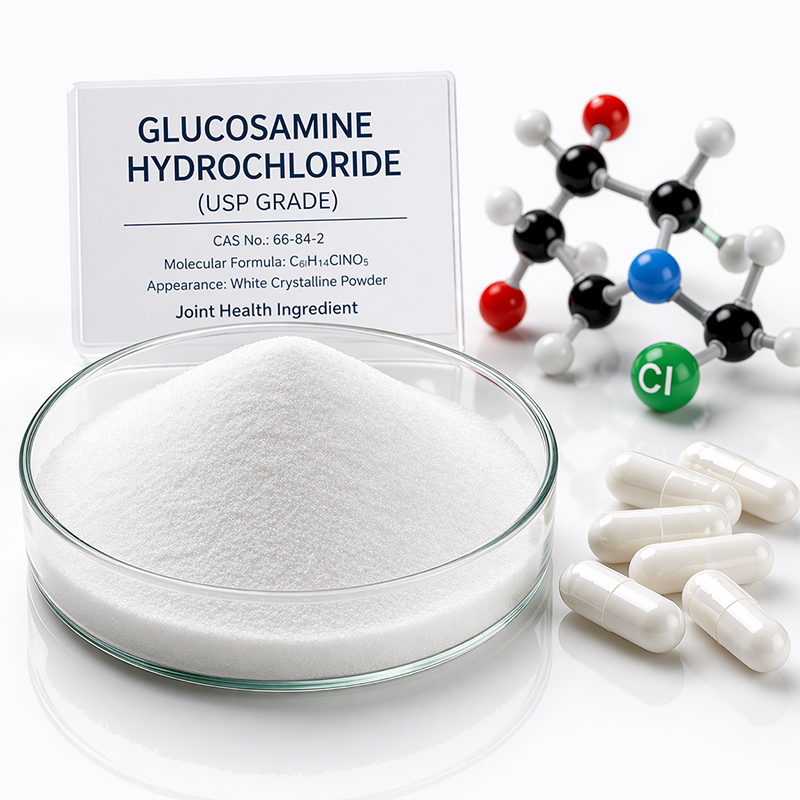
The hydrochloride compound profile offers a drastically different approach. This is an inherently stable form. We create it by binding the base aminosugar with hydrochloric acid. Unlike the sulfate alternative, it requires no additional stabilizing salts. This purity fundamentally changes how it behaves on the manufacturing floor.
The formulation advantages are substantial for modern product development. It delivers a maximum elemental yield of approximately 99%. This efficiency enables much smaller capsules and tablets. Alternatively, it leaves valuable room in the formulation matrix for secondary actives. You can easily add Chondroitin, MSM, or Curcumin without creating impossibly large pills.
Furthermore, Glucosamine Hydrochloride boasts superior stability and lower hygroscopicity. It does not clump easily. This reduces costly manufacturing rejection rates and significantly extends final product shelf life. Sourcing flexibility is another major win. You can easily source it from non-GMO, vegan fermentation processes. This avoids traditional shellfish shells and perfectly satisfies modern clean-label demands.
You must still consider the formulation limitations. There are fewer dedicated long-term clinical trials specifically highlighting the HCl form for joint health. The sulfate form dominates older medical literature. Brands relying purely on legacy clinical data often find this transition challenging from a marketing perspective.
Procurement teams often make the mistake of evaluating raw materials based on simple metrics. You need a deeper evaluation dimension framework to make profitable decisions.
Consider the critical dynamic of Cost-in-Use versus Raw Material Cost. Comparing standard price-per-kilo is highly deceptive in this context. The higher elemental yield of the hydrochloride form completely changes the math. It often results in a lower cost-in-use per active dose. Raw pricing variances simply do not tell the full formulation story.
Scalability in complex matrices is another major dimension. Lower physical volume and higher chemical stability make the hydrochloride form the superior choice. You can easily build complex multi-ingredient formulations. Liquid shots, gummy supplements, or compounded joint powders benefit immensely from this stable, high-yield profile.
We recommend following this numbered evaluation process when auditing new suppliers:
Verify Sourcing Origin: Determine if the material derives from crustacean shells or microbial fermentation.
Audit Allergen Statements: Ensure the supplier provides certified allergen-free documentation, especially for vegan claims.
Calculate True Yield: Multiply the raw material weight by the elemental percentage to find the actual active dose.
Assess Facility Controls: Check if your contract manufacturer can handle the specific moisture sensitivity of the chosen material.
Allergen and sourcing compliance currently drives major market shifts. We see a massive transition away from crustacean-derived sources. Fermented and corn-derived options dominate modern product development. Always evaluate supplier documentation meticulously for strict allergen-free claims.
Regulatory and claims considerations also dictate your final choice. You must navigate permissible structure and function claims carefully. The US FDA and strict EFSA regulations in the EU treat these ingredient forms differently. EFSA generally requires robust clinical substantiation, heavily favoring legacy sulfate data. The FDA allows broader structure/function claims, making the high-yield alternative easier to market domestically.
Table 1: Active Elemental Yield Comparison
Compound Form | Stabilizing Agent Required | Approximate Elemental Yield | Raw Material Needed for 1,500mg Active Dose |
|---|---|---|---|
Sulfate Potassium Chloride | Potassium Chloride | ~74% | ~2,027mg |
Sulfate Sodium Chloride | Sodium Chloride | ~80% | ~1,875mg |
Hydrochloride (HCl) | None | ~99% | ~1,515mg |
Switching raw materials or scaling up a new formula introduces unavoidable implementation risks. Your team must anticipate these hurdles early in the R&D process.
The most common risk involves hygroscopic failures during scale-up. Moisture ruins production runs. As a mitigation strategy, ensure your facility's HVAC systems control humidity strictly if using the sulfate form. You must also optimize excipient choices carefully. Include adequate amounts of silica or specialized stearates to manage moisture effectively during encapsulation.
Reformulation often triggers consumer pushback. Loyal buyers notice changes in pill size, color, or label phrasing. As a mitigation strategy, utilize highly transparent marketing. If transitioning a legacy product to the hydrochloride form, highlight the benefits actively. Explain the higher purity. Point out the smaller, easier-to-swallow pill sizes. Emphasize the new vegan sourcing to justify the change positively.
Quality assurance remains non-negotiable throughout this process. Rigorous third-party testing prevents costly labeling errors. Use High-Performance Liquid Chromatography (HPLC) to verify actual elemental content. Do not just rely on the total compound weight upon material receipt. Establish tight specifications with your contract manufacturer.
Chart 1: Scale-Up Troubleshooting Matrix
Observed Issue | Probable Cause | Corrective Action |
|---|---|---|
Powder sticking to tablet press punches | High ambient humidity interacting with hygroscopic sulfate forms | Lower room humidity below 40%; increase anti-adherent excipients. |
Active dose testing below label claim | Failure to account for mineral salt dilution in the sulfate complex | Recalculate input weight based on 74% elemental yield. |
Capsule shells becoming brittle over time | Hygroscopic core material pulling moisture from the gelatin shell | Switch to HPMC (vegetarian) capsules or change to the HCl form. |
Formulating a successful joint health product requires aligning your ingredient choice with your brand's specific operational realities. Use a clear shortlisting logic to guide your final decision. Choose the stabilized sulfate form if your primary buyer persona demands strict adherence to traditional clinical study formats. Your facility must also handle moisture-sensitive ingredients efficiently to make this profitable.
Conversely, choose the hydrochloride form if you formulate a modern, multi-ingredient joint supplement. It works best if you require smaller dose sizes to improve patient compliance. It is also the mandatory choice if you target the growing vegan and allergen-free market segments.
Your immediate next steps are straightforward. First, audit your current formula's elemental yield to ensure label accuracy. Second, request vegan samples from your supplier for rigorous benchtop stability testing. Finally, review current cost-in-use metrics alongside your contract manufacturer to uncover hidden production savings.
A: Both forms undergo metabolic conversion into free active aminosugars in the bloodstream. Current clinical literature heavily debates absorption nuances. However, scientific consensus confirms both effectively raise blood serum levels. They provide comparable foundational support for joint health when dosed correctly based on elemental yield.
A: The pure sulfate base degrades rapidly on its own. It pulls moisture from the air aggressively. Manufacturers add potassium chloride to provide essential chemical stabilization. This necessary processing step prevents severe moisture degradation during shipping, storage, and the encapsulation process.
A: No. A 1,500mg dose of the sulfate complex yields significantly less active compound than 1,500mg of the hydrochloride variant. The stabilization salts dilute the active yield. You must recalculate dosages mathematically to ensure label claim accuracy and consistent therapeutic delivery.
A: Currently, the hydrochloride variant is the most common fermented vegan form available at commercial scale. However, novel vegan sulfate options are slowly entering the supply chain. Sourcing methods and raw costs for these alternative vegan forms vary significantly across different global suppliers.


